 By Lawcer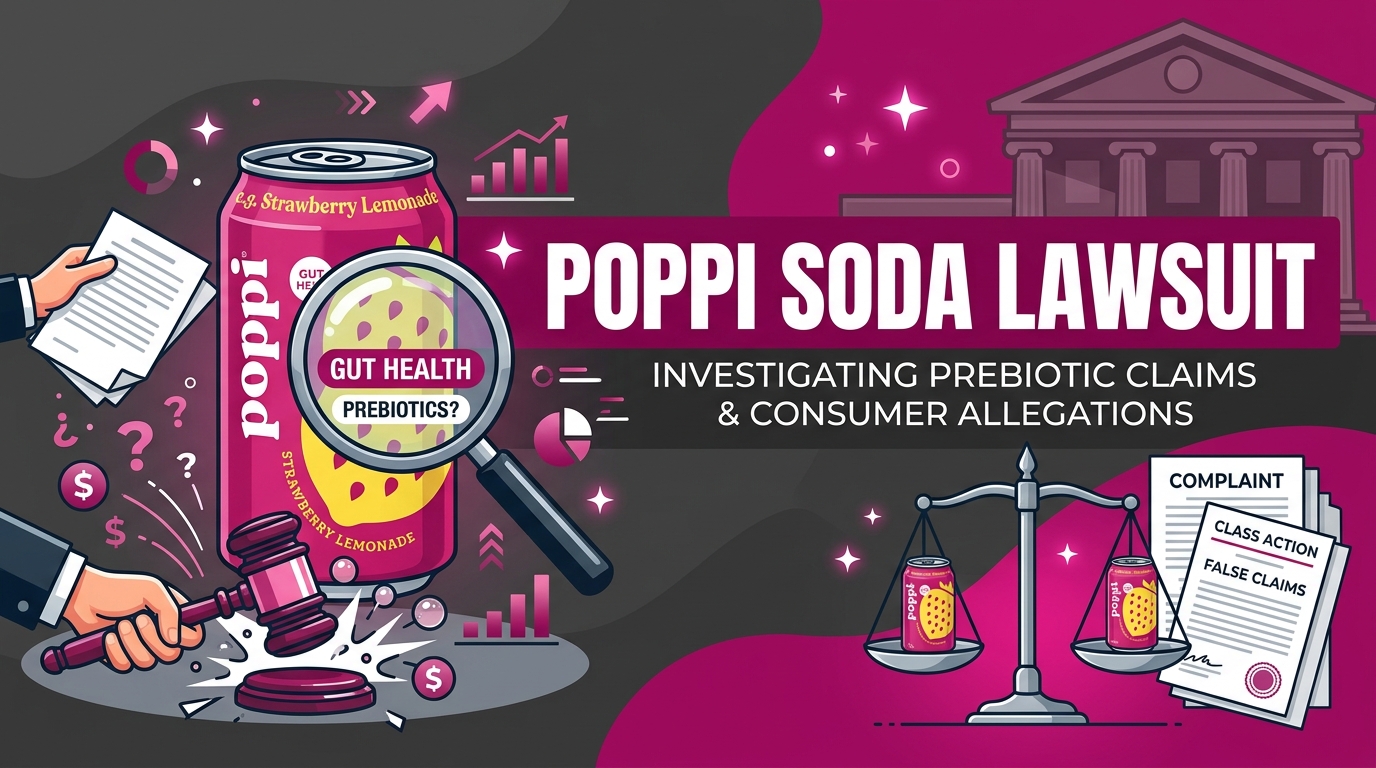
The Poppi Soda Lawsuit centers on allegations that the popular prebiotic soda brand misled consumers through its marketing of gut health benefits. Filed in 2024 in federal court in California, the consolidated class action claimed that Poppi’s labeling and advertising created false or misleading impressions about the products’ ability to deliver meaningful gut health improvements. Each can contains only approximately 2 grams of prebiotic fiber, an amount plaintiffs argued falls short of levels typically associated with noticeable benefits in scientific literature.
In early 2025 the parties reached a proposed settlement. On April 14, 2026, the United States District Court for the Northern District of California granted final approval to an $8.9 million class action settlement. As of June 2026, the claim filing period has closed, and distribution of payments to eligible class members is expected to proceed following standard administrative timelines.
This resolution matters because it illustrates how consumer protection laws apply to health-related marketing claims on everyday food and beverage products. Millions of Americans purchased Poppi during the relevant period, often at a premium price point compared with conventional sodas, in reliance on representations about prebiotic and gut health benefits. The case also reflects broader industry trends in which functional beverage companies face increasing legal and regulatory scrutiny over the substantiation of efficacy claims.
Background and Legal Context
Poppi, originally developed by VNGR Beverage, LLC and based in Austin, Texas, gained rapid popularity in the early 2020s as a “better-for-you” sparkling beverage. The brand positioned its products as containing prebiotics (typically agave inulin), apple cider vinegar, and lower sugar content than traditional sodas. Marketing materials, can labels, website content, and social media frequently used phrases such as “Prebiotic Soda,” “For a Healthy Gut,” “Be Gut Happy. Be Gut Healthy,” and “Prebiotics for a Healthy Gut.”
In March 2025, PepsiCo announced its acquisition of the Poppi brand for approximately $1.95 billion (net purchase price around $1.65 billion after tax benefits), with the transaction closing in May 2025. The class action settlement was negotiated and approved with respect to the former owner, VNGR Beverage, LLC.
The legal framework for the claims arises primarily under California law. Plaintiffs asserted violations of the Consumers Legal Remedies Act (CLRA, Civil Code § 1750 et seq.), the False Advertising Law (FAL, Business and Professions Code § 17500 et seq.), and the Unfair Competition Law (UCL, Business and Professions Code § 17200 et seq.). Additional counts included common law fraud, unjust enrichment, and breach of express and implied warranties on a nationwide basis.
These statutes prohibit false or misleading statements in advertising and labeling that are likely to deceive a reasonable consumer and are material to the purchasing decision. California courts apply an objective “reasonable consumer” test. Statements must be evaluated in the full context of the product’s formulation and the overall impression created for an ordinary purchaser. Health-related claims on food products must also align with federal Food and Drug Administration (FDA) requirements concerning nutrient content claims, structure/function claims, and the avoidance of implied disease treatment or prevention representations without proper substantiation.
Class action procedure in federal court requires plaintiffs to satisfy Rule 23 requirements for numerosity, commonality, typicality, and adequacy of representation, as well as predominance and superiority for damages classes. In practice, most consumer false advertising cases involving popular products resolve through settlement rather than trial. Courts review proposed settlements at the preliminary approval stage (to authorize notice) and again at the final approval stage (to determine whether the agreement is fair, reasonable, and adequate, after considering any objections and the results of the claims process).
Key Legal Issues Explained
The central dispute concerns whether Poppi’s marketing was likely to mislead reasonable consumers about the gut health benefits they could realistically expect from normal consumption of the product. Each can provides roughly 2 grams of prebiotic fiber from agave inulin and contains approximately 4–5 grams of sugar.
Plaintiffs contended that meaningful prebiotic effects on gut microbiota diversity, short-chain fatty acid production, or digestive comfort generally require higher daily intakes of fiber (often cited in studies in the range of 5–15 grams or more, depending on the specific fiber type and individual factors). Consuming enough Poppi to reach such levels (plaintiffs estimated more than four cans per day) would introduce additional sugar that could offset or negate purported benefits and potentially cause gastrointestinal discomfort for some individuals.
From a legal standpoint, the case raises questions about:
- Materiality and deception: Were the “gut healthy” and prebiotic representations likely to influence a reasonable consumer’s decision to purchase the product at a premium price or instead of alternatives?
- Substantiation: Did the defendant possess competent and reliable scientific evidence supporting the implied efficacy claims at the dosage provided in one serving?
- Contextual claims: Even if individual ingredients have general prebiotic properties, does the overall product formulation and marketing create an impression of significant, noticeable benefits from typical use?
- Labeling compliance: Whether certain fiber-related representations complied with FDA nutrient content claim regulations (for example, thresholds for “good source” or “excellent source” of fiber).
Defendants in such cases commonly argue that the claims constitute non-actionable puffery, that the fiber content is accurately disclosed, that prebiotic benefits are supported by general science on inulin-type fibers, and that consumers received the product they expected. Settlements allow parties to avoid the uncertainty, expense, and business disruption of continued litigation, including class certification proceedings, expert discovery on scientific substantiation, and potential trials.
Latest Developments and Case Status
The initial complaint was filed on or around May 29, 2024, in the United States District Court for the Northern District of California. Additional related cases were consolidated. A third amended consolidated complaint was filed in 2025.
Settlement discussions led to a proposed agreement in March 2025. The court granted preliminary approval on May 23, 2025, authorizing notice to the class and establishing the claims process. The claim filing deadline was September 26, 2025. Eligible individuals who purchased any flavor or package size of Poppi for household use (not for resale) between January 23, 2020, and July 18, 2025, could submit claims online or by mail.
On April 14, 2026, the court granted final approval of the settlement. As of early June 2026, the settlement is final (subject to any remaining appeal periods or administrative steps), and the settlement administrator is expected to begin or continue processing payments to approved claimants. Payments are typically issued within approximately 90 days after the settlement becomes final and effective, though exact timing depends on claims volume, verification processes, and any pro rata adjustments.
The settlement fund totals $8,900,000. This amount covers court-approved attorneys’ fees (up to approximately $2.67 million), expenses, settlement administration costs, and service awards to class representatives, with the remainder allocated to class member payments.
Who Is Affected and Potential Impact
The settlement class includes all persons in the United States who purchased Poppi beverages for household consumption during the class period. A “household” is generally defined as individuals residing in the same dwelling unit; multiple claims from the same household are typically treated as one claim.
Payout amounts vary:
- Claimants who submit valid proof of purchase (receipts or other third-party documentation) may receive compensation based on the quantity and type of products purchased (for example, up to $0.75 per single can, with tiered amounts for multi-packs). There is no strict cap for documented claims, though all payments remain subject to the total fund and potential pro rata reduction if the total value of approved claims exceeds available funds.
- Claimants without proof of purchase may receive a maximum of $16 per household.
- All approved claims are subject to a minimum payment of $5 per household.
Actual amounts distributed will depend on the total number of valid claims received (reports indicated millions of claims were filed) and deductions for administrative costs. Pro rata adjustments are common in high-volume consumer settlements when the fund is finite.
For individual consumers, recoveries are generally modest and represent only a fraction of amounts spent. However, the aggregate settlement provides a measure of accountability and returns funds to purchasers who may have relied on the challenged representations. For the company (now under PepsiCo ownership), the resolution eliminates ongoing litigation risk and associated costs while allowing focus on brand operations and potential future marketing adjustments.
Broader impacts include heightened attention among beverage and functional food companies to the substantiation of health and wellness claims, particularly those involving prebiotics, probiotics, gut health, or immunity. Similar consumer class actions have targeted other brands in the category. Companies may respond by conducting additional clinical research, using more qualified language on labels and in advertising, or reformulating products. Consumers and advocacy groups continue to monitor labeling practices in the growing functional beverage segment.
What This Means Going Forward
The Poppi Soda Lawsuit underscores that marketing claims implying specific health benefits from functional ingredients must be carefully calibrated to the actual formulation and supported by competent evidence. Courts and regulators evaluate claims from the perspective of the reasonable consumer viewing the product as a whole, not in isolation.
For the public, the case serves as a reminder to approach “gut healthy,” “prebiotic,” or similar functional claims with informed skepticism and to review ingredient quantities and nutrition facts alongside marketing language. While prebiotic fibers such as inulin can contribute to digestive health as part of a balanced diet, individual results vary, and a single serving of a beverage provides only a modest amount.
Legally, the settlement reinforces established principles under state consumer protection statutes without creating new precedent through a litigated judgment. Future cases will continue to turn on the specific wording of claims, the dosage provided, and the quality of substantiation. Companies operating nationwide must remain attentive to the strictest state standards (California being particularly active) as well as evolving FDA guidance on fiber, prebiotics, and structure/function claims.
Industry observers may watch for any labeling or formulation changes implemented by Poppi or similar brands following this resolution, as well as any further regulatory activity concerning prebiotic claims in conventional foods versus dietary supplements.
Frequently Asked Questions
What were the primary allegations in the Poppi Soda Lawsuit?
Plaintiffs alleged that Poppi’s marketing and labeling, including phrases such as “For a Healthy Gut” and “Prebiotics for a Healthy Gut,” were false or misleading because each can contains only about 2 grams of prebiotic fiber. They claimed that meaningful gut health benefits would require consuming significantly more product than a typical consumer would drink in a day, and that the added sugar content could offset any potential benefits.
Has the Poppi class action been resolved?
Yes. The parties reached a proposed $8.9 million settlement that received final court approval on April 14, 2026. The claims filing period closed on September 26, 2025. Distribution of payments to eligible class members is now in process or imminent.
Who is eligible to receive payment from the Poppi settlement?
Individuals in the United States who purchased any flavor or package size of Poppi for household use (not for resale) between January 23, 2020, and July 18, 2025, and who submitted a timely, valid claim are eligible, subject to approval by the settlement administrator. One claim is generally permitted per household.
How much can a person expect to receive?
Amounts vary based on proof of purchase and the total number of approved claims. With documentation, payments are calculated according to the volume purchased (examples include up to $0.75 per single can or tiered pack amounts). Without proof, the maximum is $16 per household. All approved claims have a $5 minimum. Actual payments may be adjusted pro rata depending on fund availability after costs.
Did Poppi admit wrongdoing as part of the settlement?
No. The settlement agreement states that the defendant denies any wrongdoing or liability. Settlements in class actions are frequently reached to avoid the costs and uncertainties of continued litigation without any admission of fault.
What legal standards govern health claims on beverages like Poppi?
Claims are evaluated under state consumer protection laws (such as California’s CLRA, FAL, and UCL) using a reasonable consumer standard. Federally, the FDA regulates nutrient content claims, structure/function claims, and prohibits misleading labeling. Companies must ensure that implied benefits are substantiated and that claims do not overstate the effects of the amount of ingredient actually present in a typical serving.
Conclusion
The Poppi Soda Lawsuit has concluded with court-approved settlement providing compensation to eligible purchasers while allowing the company to move forward without protracted litigation. The case highlights the legal risks associated with health and wellness marketing claims in the competitive functional beverage category and the protections available to consumers under established false advertising and unfair competition laws.
This article is for informational purposes only and does not constitute legal advice. Readers who believe they may have claims or who seek personalized guidance regarding consumer rights or product labeling should consult a qualified attorney licensed in their jurisdiction. For official information about the settlement, including claim status, visit the court-approved settlement website or contact the settlement administrator. Individuals interested in ongoing developments in consumer protection or food labeling law are encouraged to monitor resources from the FDA, state attorneys general, and reputable legal news outlets.
You May Also Like: Armor Correctional Health Services Lawsuit: A Complete Overview