 By Lawcer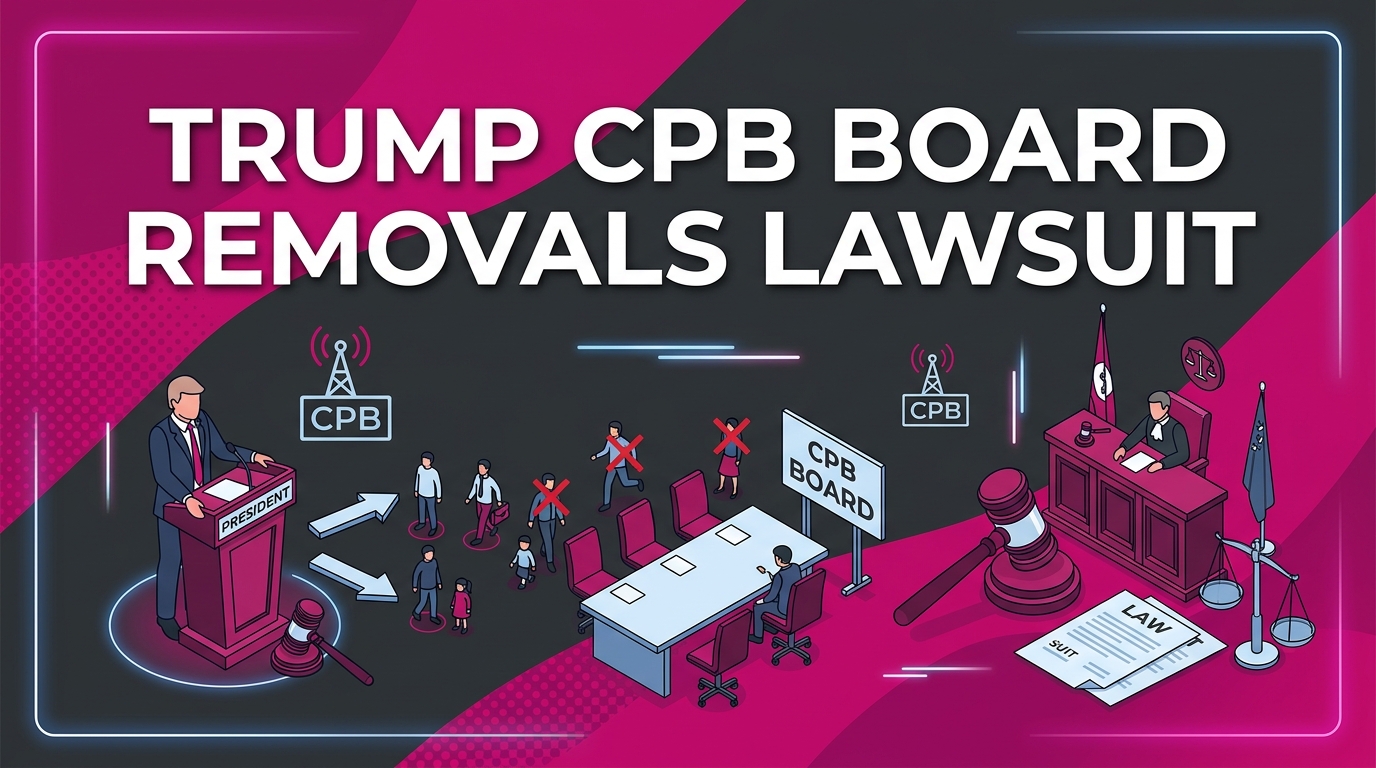
In April 2025, President Donald Trump directed the removal of three members of the Corporation for Public Broadcasting (CPB) board. The Corporation for Public Broadcasting responded by filing suit in federal court, arguing that the President lacked legal authority to take such action. The Trump CPB Board Removals Lawsuit raised fundamental questions about the limits of executive power over a congressionally created private nonprofit corporation designed to support public media with a measure of independence.
The case, filed in the U.S. District Court for the District of Columbia, centered on whether the President could remove board members of an entity structured by statute to operate outside direct federal agency control. A federal judge denied emergency relief in June 2025 but allowed the challenged board members to remain in place under amended corporate bylaws. Subsequent developments, including congressional action to rescind CPB funding and the eventual dissolution of the corporation in early 2026, rendered the dispute moot. On January 14, 2026, the court dismissed both the original lawsuit and a related government countersuit.
This article explains the Trump CPB Board Removals Lawsuit in clear terms: what happened, the core legal principles involved, the procedural history, who was affected, and what the resolution means for public media governance and executive authority. The information draws from court filings, statutory text, and public records. This article is for informational purposes only and does not constitute legal advice.
Background & Legal Context
The Corporation for Public Broadcasting was established by the Public Broadcasting Act of 1967. Congress created CPB as a private, nonprofit corporation under the laws of the District of Columbia to distribute federal appropriations to public television and radio stations. The statute (codified at 47 U.S.C. § 396) explicitly describes CPB as “a nonprofit corporation” and states that its board members “shall not be deemed to be officers or employees of the United States.”
The legislative intent was to shield public broadcasting from direct political interference while still providing public funding. Congress provided that the President would appoint board members with the advice and consent of the Senate for staggered six-year terms. The statute includes safeguards against federal direction or control of programming and editorial decisions. It emphasizes that CPB exists to “facilitate the development of a national public broadcasting system” that serves diverse audiences, including those in rural and underserved areas.
CPB is not a traditional federal executive agency. Unlike cabinet departments or independent regulatory commissions such as the Federal Trade Commission or the Federal Communications Commission, CPB operates under corporate governance principles. It receives annual appropriations from Congress (historically around $500 million in recent years before the 2025 rescission) but distributes those funds through grants and contracts to local public media stations. The board oversees policy, finances, and grant-making but does not produce content itself.
Presidential removal power over appointed officials has long been a subject of constitutional debate. The Supreme Court addressed related issues in landmark cases. In Myers v. United States (1926), the Court recognized broad presidential authority to remove purely executive officers. In Humphrey’s Executor v. United States (1935), the Court upheld “for cause” removal protections for members of independent agencies performing quasi-legislative or quasi-judicial functions. More recent decisions, such as Seila Law LLC v. Consumer Financial Protection Bureau (2020) and Collins v. Yellen (2021), have narrowed the circumstances in which Congress may insulate agency leaders from at-will removal, particularly when they exercise significant executive power.
In the context of CPB, the Public Broadcasting Act contains no explicit provision authorizing the President to remove board members at will or for cause. Plaintiffs in the Trump CPB Board Removals Lawsuit argued that this statutory silence, combined with the private corporate structure and explicit disclaimers against federal officer status, meant the President lacked removal authority altogether. The administration countered that, as presidential appointees exercising functions affecting federal funds, the board members remained subject to Article II oversight.
This tension between congressional design for independence and executive removal authority formed the legal foundation of the dispute. Similar questions have arisen with other congressionally chartered corporations or entities, though few have reached the level of public attention seen in the Trump CPB Board Removals Lawsuit.
Key Legal Issues Explained
The Trump CPB Board Removals Lawsuit turned on several interlocking legal doctrines that non-lawyers encounter infrequently but that shape government structure.
First, the scope of presidential removal power. The Constitution vests executive power in the President (Article II, Section 1). Courts have interpreted this to include a default authority to remove officers unless Congress imposes valid limitations. The central question was whether CPB board members qualify as “officers of the United States” subject to that power or whether the statute’s designation of them as private corporate directors placed them outside it. Plaintiffs cited the statutory language in 47 U.S.C. § 396(d)(2) that board members “shall not be deemed to be officers or employees of the United States” and argued this reflected congressional intent to create an insulated entity.
Second, separation of powers. The lawsuit implicated the balance between Congress’s authority to create entities and structure their governance versus the President’s constitutional role in executing laws. Plaintiffs claimed that unilateral removal interfered with Congress’s design for a nonpartisan public media funding mechanism. The government maintained that the President retains supervisory authority over the use of federal appropriations.
Third, the Administrative Procedure Act (APA). Plaintiffs alleged that the removal notices constituted arbitrary and capricious agency action. The APA allows courts to set aside final agency actions that violate statutory or constitutional limits. Because the removals came directly from White House personnel officials, the case also raised questions about whether such actions constituted reviewable “agency action.”
Fourth, corporate governance under District of Columbia law. After receiving termination notices, CPB amended its bylaws pursuant to the District of Columbia Nonprofit Corporation Act. The new provision required a two-thirds vote of the remaining directors to remove any board member. This procedural safeguard, rooted in ordinary corporate law applicable to nonprofits, allowed the challenged members to continue serving despite the President’s directive. The court acknowledged this change in its preliminary ruling.
These issues are not abstract. They affect how public institutions operate in practice. For example, if presidents could freely remove directors of entities like CPB, it could influence grant decisions or programming priorities at local stations that rely on federal support. Conversely, overly rigid insulation from executive oversight could raise accountability concerns regarding the expenditure of taxpayer dollars.
Latest Developments or Case Status
The timeline of the Trump CPB Board Removals Lawsuit unfolded rapidly in 2025 before becoming moot in 2026.
On April 28, 2025, the White House Presidential Personnel Office sent email notices terminating three board members: Laura G. Ross, Diane Kaplan, and Thomas E. Rothman. Hours later, CPB, its board, and the three individuals filed suit in the U.S. District Court for the District of Columbia (docket 1:25-cv-01305) before Judge Randolph D. Moss. They sought a temporary restraining order, preliminary injunction, and declaratory judgment that the removals were unlawful.
Judge Moss held hearings and, on June 8, 2025, denied the request for preliminary injunctive relief. He concluded that plaintiffs had not demonstrated a strong likelihood of success on the merits or that they would suffer irreparable harm in the absence of an injunction. The court observed that Congress appeared to have contemplated some degree of presidential influence over CPB. However, because CPB had amended its bylaws to require a supermajority vote for removal, the three members remained on the board. CPB publicly affirmed their continued service.
On July 15, 2025, the Department of Justice filed a separate lawsuit on behalf of the United States against the three individuals. The complaint sought a declaration that they had been lawfully removed, an injunction barring them from serving, and recovery of any compensation received after the removal date.
Meanwhile, broader developments affected CPB’s viability. On May 1, 2025, President Trump signed Executive Order 14290 directing the cessation of federal funding for NPR and PBS. Congress later passed a rescissions bill that eliminated CPB’s appropriations. By August 2025, CPB announced plans to wind down operations. On January 5, 2026, the CPB board voted to dissolve the corporation entirely.
On January 14, 2026, Judge Moss dismissed the original lawsuit and the government’s countersuit as moot. The parties had filed a joint status report noting the corporation’s dissolution and the resignation of remaining individual plaintiffs. With no ongoing corporate entity or live controversy, the court closed the case without ruling on the underlying merits of presidential removal authority.
A related challenge to the funding restrictions in Executive Order 14290 resulted in a March 31, 2026 ruling by the same judge that blocked certain viewpoint-based defunding on First Amendment grounds. By then, however, CPB’s dissolution had already altered the landscape for public media funding.
Who Is Affected & Potential Impact
The Trump CPB Board Removals Lawsuit directly touched several groups.
Public media stations and their audiences were among the most affected. Local PBS and NPR affiliates across the country rely on CPB grants for programming, infrastructure, and emergency alert systems. Uncertainty over board governance and funding created operational challenges during the litigation period. Rural communities and educational broadcasters, which often depend more heavily on federal support, faced the greatest risk if grant-making processes were disrupted.
Board members and corporate officers experienced immediate professional and legal consequences. The three individuals who received termination notices spent months defending their positions in court while continuing to serve under the bylaws safeguard. Two of them later voluntarily dismissed their personal claims. The litigation also imposed costs on the corporation in legal fees and administrative resources.
Taxpayers and Congress had an interest in the outcome. CPB administered hundreds of millions in annual appropriations. Questions about accountability for those funds lie at the heart of the removal power debate. Congressional appropriators who designed the 1967 framework sought to balance funding with insulation from day-to-day political control.
Broader institutional implications extended to other congressionally chartered nonprofits and independent entities. A definitive ruling on removal authority could have provided precedent for similar organizations in education, culture, or research funding. Because the case ended without a merits decision, those questions remain unresolved for future disputes.
What This Means Going Forward
The mootness of the Trump CPB Board Removals Lawsuit leaves several legal and practical questions open. Courts did not issue a binding precedent on the extent of presidential removal power over CPB-style entities. Future administrations and Congresses may revisit the governance structure of public media funding mechanisms or similar corporations.
For public broadcasting, the dissolution of CPB has shifted reliance toward private donations, state and local support, corporate underwriting, and alternative federal grant programs. Stations have reported adapting through increased fundraising and programming adjustments. The March 2026 ruling on First Amendment grounds in the related funding case may limit certain types of viewpoint-based conditions on public media support, though appeals and further legislative action remain possible.
Legal observers should monitor developments in removal power jurisprudence at the Supreme Court level. Any future case involving presidential appointees to independent or quasi-independent bodies could clarify or modify the framework established by Humphrey’s Executor and its progeny.
Practically, organizations receiving federal support through nonprofit intermediaries may review their bylaws and corporate documents to clarify removal procedures. Congress retains authority to amend the underlying statute or restructure funding mechanisms entirely.
Readers monitoring public media or regulatory governance should track congressional oversight hearings, appropriations bills, and any new litigation involving similar entities. The intersection of executive authority, corporate structure, and public funding continues to evolve.
Frequently Asked Questions
What is the Corporation for Public Broadcasting?
CPB is a private nonprofit corporation created by Congress in 1967 under the Public Broadcasting Act. It distributes federal funds to public television and radio stations but does not produce or control content. Its board members are presidential appointees confirmed by the Senate, yet the statute designates them as non-federal officers to promote independence.
Why did the Trump administration attempt to remove CPB board members in 2025?
The administration sent termination notices to three sitting board members on April 28, 2025. Public statements and related executive actions indicated a policy focus on reducing perceived bias in publicly funded media and exercising greater oversight over federal appropriations distributed through CPB.
Did the court decide whether the President could legally remove the board members?
No. The U.S. District Court denied preliminary relief in June 2025 but never reached a final ruling on the merits. The case became moot after CPB’s dissolution in January 2026, and the court dismissed it without deciding the core removal authority question.
What role did CPB’s bylaws play in the dispute?
Following the removal notices, CPB amended its bylaws under District of Columbia nonprofit law to require a two-thirds vote of directors for any removal. This corporate governance mechanism enabled the challenged members to continue serving despite the President’s directive and factored into the court’s assessment of irreparable harm.
How does the Trump CPB Board Removals Lawsuit connect to funding for NPR and PBS?
The lawsuit occurred alongside executive and legislative efforts to curtail federal support for public broadcasting. While the board removal case focused on governance, parallel actions targeted funding distribution. A separate March 2026 ruling blocked certain funding restrictions on First Amendment grounds, but CPB’s dissolution had already ended its role as the primary funding conduit.
Is the Trump CPB Board Removals Lawsuit still active as of May 2026?
No. Both the original lawsuit and the government’s countersuit were dismissed as moot on January 14, 2026, following CPB’s dissolution. No appeals or related proceedings have been reported.
Conclusion
The Trump CPB Board Removals Lawsuit highlighted enduring tensions between executive authority and congressional efforts to insulate certain public functions from direct political control. Although the case did not produce a definitive judicial pronouncement on presidential removal power over CPB’s board, it illustrated how statutory structure, corporate bylaws, and practical developments such as funding rescissions can shape outcomes in high-profile governance disputes.
Public media continues to serve millions of Americans through local stations that have adapted to new funding realities. The legal principles at stake—separation of powers, statutory interpretation, and corporate independence—remain relevant to other federally supported entities. As governance and funding debates evolve, interested parties should consult official court records, congressional documents, and qualified legal counsel for developments specific to their circumstances.
You May Also Like: NorthStar Financial Lawsuit: A Complete Overview for Readers